Most of what's written about pet insurance is written by people selling it. Comparison sites rank carriers. Insurers explain their own exclusions. Almost nobody publishes what actually happens after the claim is filed — so we started keeping a log.
Our Real Claim Log now holds 97 outcomes drawn from public posts: 83 from Reddit, 14 from BBB complaints. Each entry links back to the original post, so you can read the source and judge for yourself. We don't edit the stories into wins and losses for a ranking table. We just record what happened.
This report is our first read of that data.
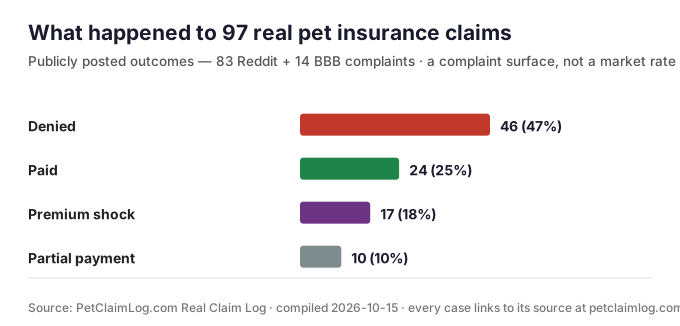
Of the 97 outcomes in the log, 46 claims were denied outright (47%), 24 were paid, 10 were partially paid, and 17 describe premium shocks at renewal rather than a single claim.
That 47% is not the market's denial rate. It is the rate among publicly posted complaints — people whose claims were paid rarely write long posts about it. Treat this as a map of where things go wrong, not a measure of how often.
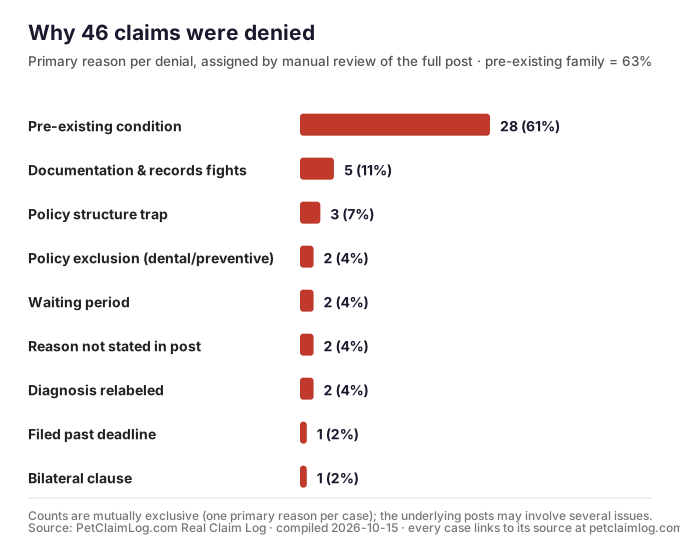
We read all 46 denials and assigned each one a primary reason (method below). One case can involve several disputes; we picked the reason the insurer actually leaned on.
| Primary denial reason | Cases | Share of denials |
|---|---|---|
| Pre-existing condition | 28 | 61% |
| Documentation & records fights | 5 | 11% |
| Waiting period | 2 | 4% |
| Diagnosis relabeled | 2 | 4% |
| Policy exclusion (dental/preventive) | 2 | 4% |
| Policy structure trap | 3 | 7% |
| Bilateral clause | 1 | 2% |
| Filed past deadline | 1 | 2% |
| Reason not stated in post | 2 | 4% |
| Pre-existing family (incl. bilateral) | 29 | 63% |
Pre-existing conditions and their close cousin, the bilateral clause, account for 29 of 46 denials (63%). This matches what consumer surveys report — MarketWatch Guides and ValuePenguin both found pre-existing conditions and waiting periods at the top of their denial lists (verified October 2026) — but survey respondents remember categories. Our log shows the mechanics.
The pre-existing clause sounds simple: the condition existed before coverage started, so it isn't covered. The disputes in our log are rarely that simple. The fight is usually about what counts as the condition, and when it started. Reading the 28 pre-existing denials closely, we found they turn on distinct anchors — plus 5 posts that never state the anchor at all.
9. A symptom or past episode becomes the condition. A cat vomited "a few times in 2022"; two years later, a new stomach illness is denied. A dog had one recorded episode of diarrhea; severe hemorrhagic gastroenteritis is denied because "diarrhea" appears in the record. The owner's appeal in that case makes the boundary explicit: diarrhea is a symptom, not a diagnosis. The insurer disagreed. In two more cases, an earlier episode anchored a later denial outright: a past urinary incident was used against a FLUTD blockage even though a vet letter said the two were unrelated, and a 5-year-old note about a cat licking treats off its paw anchored a denied procedure years later.
3. One sentence in a pre-enrollment checkup. An 8-week wellness exam notes the breed's risk of stenotic nares. Months later, the surgery is pre-existing. A breeder's vet mentions a sprained leg three days before adoption; that note becomes the anchor for a later injury dispute. And a tentative, unconfirmed asthma diagnosis noted before enrollment was enough for the insurer to state that anything respiratory "will not be covered ever" — even though the cat's own vet says his inflamed lungs don't look like asthma.
2. The switcher's trap. Owners who changed carriers mid-life got denied on records from the previous insurer — brief vomiting episodes, an allergy treatment started a year earlier. One owner put it bluntly: "The next insurance will have a lot more to deny."
1. The symptom dated one day before the effective date. Eye symptoms documented the day before coverage began made the entire eye pre-existing — including glaucoma drops prescribed later. The insurer's own response on the complaint page confirms the logic.
1. A note from the fostering period. Allergies observed while the dog was in foster care, before the adopter bought the policy, denied every claim — and the renewal premium rose 50% at the same time.
1. Lab values from two years earlier. Results "barely out of range" two years before the policy started, since resolved, anchored the denial of a chronic illness claim.
1. Records from a vet the pet never saw. A denial letter cited records from a clinic the cat had never visited; a $300 surgery was ruled pre-existing and used against the remaining $8,000+ treatment.
1. The diagnostic test itself gets relabeled. A puppy insured since weeks old developed Giardia. The test that found it was classified as "wellness and preventative" — not covered — and the condition was marked pre-existing anyway. The appeal took 40 days.
1. A concurrent condition gets blamed for the workup. X-rays to rule out an intestinal blockage found nothing — so the insurer stipulated the workup must have been about the Giardia the puppy had at the time, a pre-existing condition. Over $2,000 in X-ray bills denied on that linkage. Commenters were blunt: nobody X-rays for Giardia.
1. A preventive-care decision becomes the anchor. A senior, diabetic cat developed mammary cancer; the $12,000+ surgery was denied because the cat "wasn't spayed earlier" — which the insurer framed as the owners disregarding veterinary advice. The owners say multiple vets had advised delaying the spay because anesthesia could kill her.
1. Paid first, denied later. An initial accident claim was approved and paid. The orthopedic surgery that followed was then denied under the 6-month orthopedic waiting period, linked back to the first injury. (This case also involves the waiting period; we filed it under pre-existing because that was the final, decisive ruling.)
1. The one denial we agree with. An owner bought a policy specifically to cover a cystitis condition the cat already had, and said so at signup. The claim was denied as pre-existing. That denial is correct under every carrier's terms we've read, and we say so because a log that only collects outrage isn't evidence.
(The remaining 5 pre-existing denials don't state the anchor in the source post.)
5 denials were documentation fights. One claim sat unpaid while automated emails demanded puppy records from 2015. Another was closed twice for "insufficient documentation" — submitted by an owner who works at the vet clinic, with the neurologist CC'd. A third saw its denial reason change three times across three letters — pancreatitis, then IBD, then chronic enteropathy — with no biopsy ever performed. And one cat's claims kept closing unpaid because the first vet clinic simply wouldn't release the SOAP notes the insurer required.
Three denials came from policy structure rather than medicine: an insurer demanded a "breeder amendment" that could not be added to the policy; another required a signup health checkup it never chased for two years — while collecting premiums and paying one small claim; and a third invoked a "previously treated and the treatment failed" rule to reject an entire dermatology invoice — a wording a vet commenter who uses the same insurer called incorrect and worth appealing.
17 of the 97 outcomes aren't claims at all. They're renewal notices: a $100/month Bulldog policy jumping to $154 at age six, a +300% increase discussed on a thread where the top comment describes a pre-existing denial based on resolved lab values. Premium cases rarely make appeal guides, but they belong in any honest picture of the product.
The full log, with every source link, is at /claims.
Citation: PetClaimLog. (2026). We read 97 real pet insurance claim outcomes — here's what they show. Retrieved from https://petclaimlog.com/claims-report
Embed the charts — free for editorial use with attribution to PetClaimLog.com. Copy this HTML:
<!-- PetClaimLog claim data charts - free editorial use with attribution to PetClaimLog.com -->
<img src="https://petclaimlog.com/charts/chart_outcome_mix.svg" alt="Outcome mix of real pet insurance claim outcomes (PetClaimLog.com)" style="max-width:100%">
<img src="https://petclaimlog.com/charts/chart_denial_reasons.svg" alt="Primary denial reasons for real pet insurance claims (PetClaimLog.com)" style="max-width:100%">
<p>Source: <a href="https://petclaimlog.com/claims-report">PetClaimLog.com Real Claim Log analysis</a></p>
Journalists and writers: the underlying data (every case, with its source link) is at petclaimlog.com/claims. For questions or the raw classification table, contact through our about page.